WHY AREN’T CUSTOMERS MOVING?

An executive brief from The Illusion of Commercial Control
We have never had more visibility into selling or more tools to control it. Yet customers are still struggling to buy. Something doesn’t add up.
Over three decades, commercial organizations have built extraordinary capability around selling. Methodologies created consistency. CRM created visibility. Technology made seller behavior increasingly measurable. AI promises to make the entire system faster and more precise.
Yet Forrester found that 86% of B2B purchases stall during the buying process, while Gartner found that 74% of B2B buying teams experience unhealthy conflict.
If our commercial systems are helping us get better at selling, why aren’t they making customers better at buying?
We May Be Measuring the Wrong Thing
Most commercial organizations are very good at producing evidence about the seller. Do we have a champion? Have we reached the economic buyer? Do we know the decision process? When will it close? All are reasonable questions. But they are not the same as asking: What is different inside the customer because of what we did?
Qualification helps us understand the opportunity. It does not necessarily cause the customer to move. A well-diagnosed stalled deal is still a stalled deal.
Customer movement is an observable change in the customer organization’s thinking, alignment, commitment or behavior that reduces uncertainty and makes a decision more possible.
When Customers Stop Moving, We Turn Inward
A deal stalls. Forecast risk rises. Management wants greater certainty. Inspection increases. More seller evidence is produced. The opportunity becomes easier to describe, but nothing necessarily changes inside the customer.
The less the customer moves, the more the organization turns inward. We call this the Commercial Control Loop.
That raises a more uncomfortable possibility: what if greater visibility into selling is creating the appearance of control without making customers any more capable of moving?
AI Raises the Stakes
AI is about to make our commercial systems faster and more efficient. But what exactly are we asking it to accelerate?
If the system rewards activity, AI can create activity faster. If it rewards documentation, AI can improve documentation. And if seller evidence is mistaken for customer movement, AI can make a stalled opportunity look extraordinarily well understood.
The question is not whether AI will change selling. It is whether we have designed the right system for AI to accelerate.
Test It Against Your Own Pipeline
Take the five opportunities your organization is most dependent upon and run a simple test.
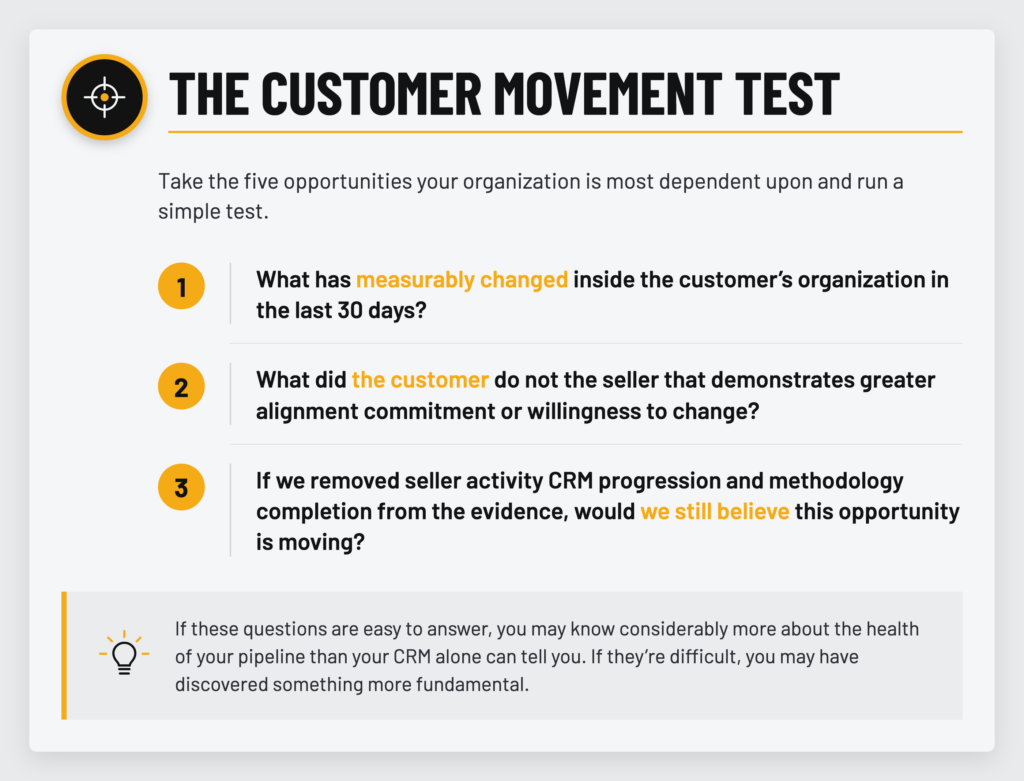
The point is not to create another deal score. It is to expose the difference between what we know about our selling and what we can prove has changed inside the customer.
Ask what your commercial system has been teaching you to see.
Go Deeper
If the evidence is weak, the issue may be larger than the five deals. The complete papers examine why commercial systems can unintentionally reinforce seller evidence over customer movement, why the problem becomes more consequential in complex enterprise buying, and what changes when strategy and customer movement become the starting point. Pick the version that best fits your organization.